WORDS by FOSTER KAMER
ART by ALEXIS JAMET
The authorship of the Homeric poems is a complex and difficult topic, because these written texts emerge from a long oral tradition. Marks of this distinctive legacy are visible in The Odyssey on the level of style. Dawn appears some twenty times in The Odyssey, and the poem repeats the same line, word for word, each time: emos d’erigeneia phase rhododaktulos eos.
“ But when early-born rosy-fingered dawn appeared ...”
There is a vast array of such formulaic expressions in Homeric verse, which suggest that things have an eternal, infinitely repeatable presence. Different things will happen every day, but Dawn always appears, always with rosy fingers, always early.
— Emily Wilson, in the introduction to her translation of Homer’s The Odyssey.
“Tell me about a complicated man.
Muse, tell me how he wondered, and was lost...”
— Homer, in the first words of The Odyssey.
“Every time the sun comes up, I’m in trouble.”
— Sharon Van Etten
This all started because I woke up in the wrong bed on a cold morning last January.
The mid-morning sun cut through half-closed curtains and broke the bedroom’s darkness with piercing, scattered shards of light. Half-blinded by an absolute prick of a sunbeam and using my hand as a visor, I opened up the book at the foot of the bed, squinting, read the first page, closed it, and bought it on my phone. It showed up two days later: The Odyssey. I dragged it around for the next year, dog-eared to hell, proselytizing the virtues of this 3,000-year-old swashbuckling, poetic, madcap shitshow of fun to whoever would listen.
If you’ve read it—and a shouldn’t-be-surprising number of people I know have and were half-annoyed, half-amused by my new fervor for it—none of this will be new to you. But the hero of the original epic was a motherfucker. Odysseus was a liar, cheat, philanderer, murderer, thief; a vengeful, petty asshole; and more than kind of a shithead. He was also a brilliant tactician, a clever son of a bitch, a romantic, a man of a series of complex and spiderwebbing and overlapping principles, and nothing if not persistent. Every day, for ten years—after gods and goddesses and seas and skies all conspired against him—he woke up, pointed toward home, and got to work.
It shouldn’t surprise me that, like large swaths of civilization, I somehow found one of the oldest stories in recorded history to be relatable and totally readable, but there it is.
I know.
Two more things, and then we’re done with Homer.
The first: In a New York Times Magazine profile of Wilson before her translation came out, a critic named Guy Davenport is quoted: “The ‘Iliad’ is a poem about force; the ‘Odyssey’ is a poem about the triumph of the mind over force.”
The second is this: ever since I read that aforementioned epigraph about “rosy-fingered dawn,” those words have been somewhere in my head every day, every moment since. Not always at the forefront, or even close—sometimes, they’re all the way in the cut, deep in the cheap seats. But they’re there. I think of them every time I wake up and when I’m crashing. I think of them at night, in bars with loud, thumping music and light-up dance floors, in prewar buildings, in glass skyscrapers, in theaters, in restaurants, in the office, in the office bathroom, in my morning shower. I think of them in tunnels and over bridges, on planes above the cloud cover. I think of them as those last pink streaks of sunlight are cauterized into the topaz hues of early evening dusk. I think of them at nearly every time except for one: rosy-fingered dawn.
I am not a morning person.
I’ve never really been one. And I wish I were. I wish I could speak of rosy-fingered dawn to its hand.
Every time I think of rosy-fingered dawn, my heart breaks a little knowing what I’ve missed—that it’s just right there. It’s just right there for the taking.

I once worked on a project that involved talking to, of all things, a sleep scientist.
This feels like something that you probably already know, but for the sake of putting the anchor in the wall, let’s state that it’s true: There’s actually a biological difference between morning people and not-morning people. (Or, I guess you could say, night people.)
Circadian rhythm is a real thing and not just some semi-science-y bullshit. So-called self-designated “bicoastals” saying they’re jet-lagged might, unfortunately, have a physiological pardon (though not one that absolves them for being the kind of asshole who refers to themselves as “bicoastal”).
Here’s how it works: Your circadian systems regulate your biological schedule. They respond to environmental factors like light and sound and eating schedules; they make you sleepy (by telling your brain to secrete melatonin, for example). They keep you going to the bathroom at, ideally, regular times. These systems (and rhythms) are present in all kinds of biological forms all over the world: humans, animals, plants, even fungi. In 2017, a Nobel Prize went to a scientist who discovered the way the circadian systems of fruit flies work on a molecular level. (The guy was a guest on Wait Wait…Don’t Tell Me! If you’re the kind of person who enjoys Wait Wait, and I am, shit was pretty funny. Paula Poundstone gave him the third degree.)
Where this system concerns us and this whole morning-person mess, is the binary under which we break down into two types: larks and owls, morning people and night people.
Larks keep an earlier schedule. They get tired earlier in the night; they go to bed earlier in the night; they wake up earlier in the day. Then you have owls—yes, night owls—who are “phase-delayed.”As in, the phases that most people run through earlier in the night are delayed in them. They get tired later in the night and wake up later in the morning.
With enough practice, one can, supposedly, become a morning person—and one might want to. In the August 2019 issue of medical journal Sleep Medicine, there’s a study that concludes: “Resetting the late timing of ‘night owls’ has a positive impact on mental health and performance.” Sleep scientists tried to flip night owls into morning people without sleep drugs, and they succeeded. They used “light exposure, fixed meal times, caffeine intake, and exercise”—all the boring shit we should be doing anyway. And, of course, people’s lives got better from the study. “Significant improvements to self-reported depression and stress, as well as improved cognitive and physical performance measures,” the paper’s abstract brags. In addition to the basic stress of going against societal norms and the nine-to-five of it all, night owls are, per the scientists, “associated with health issues, mood disturbances, poorer performance and increased mortality rates.”
If you’re not a morning person, the mere act of missing the sun rising—of not being able to take advantage of a full day—can already make you feel like you’re somehow behind from the moment you wake up.
Maybe I like mornings, but not enough.
Or maybe I am, in fact, a “night person.” I might just be someone who feels most at ease and able in the most social and loneliest of hours—both the most raging parts of parties and most desolate moments before dawn. Sometimes this is exhilarating; often, it’s alienating; occasionally, it’s devastating.
Maybe it’s one big lesson in the inextricable agony of life that is: we are who we fucking are, and we can’t change, but we can fight it. And if we somehow manage to win that fight enough times, again and again and again, maybe the nature of that fight changes, and it frees us to go after whatever’s over that horizon. I’ve seen it done.
Maybe we are just a bunch of recursions.

NEED SOME HELP IN THE MORNING?
-
Vendor:
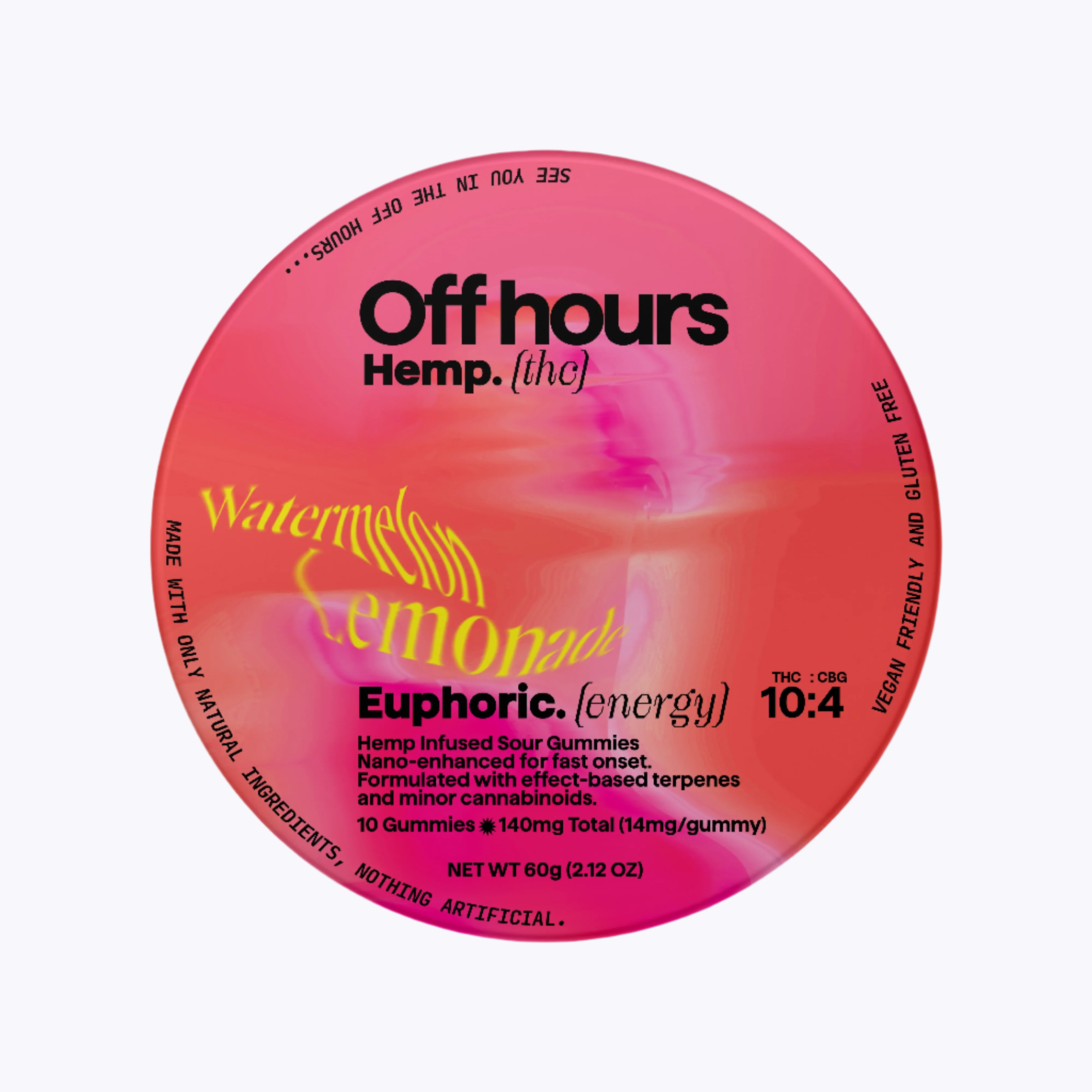
Off hoursEuphoric Watermelon Lemonade Gummies - 10mg THC and 4mg CBGRegular price $30.00Regular price Sale price $30.00Unit price per -
Vendor:
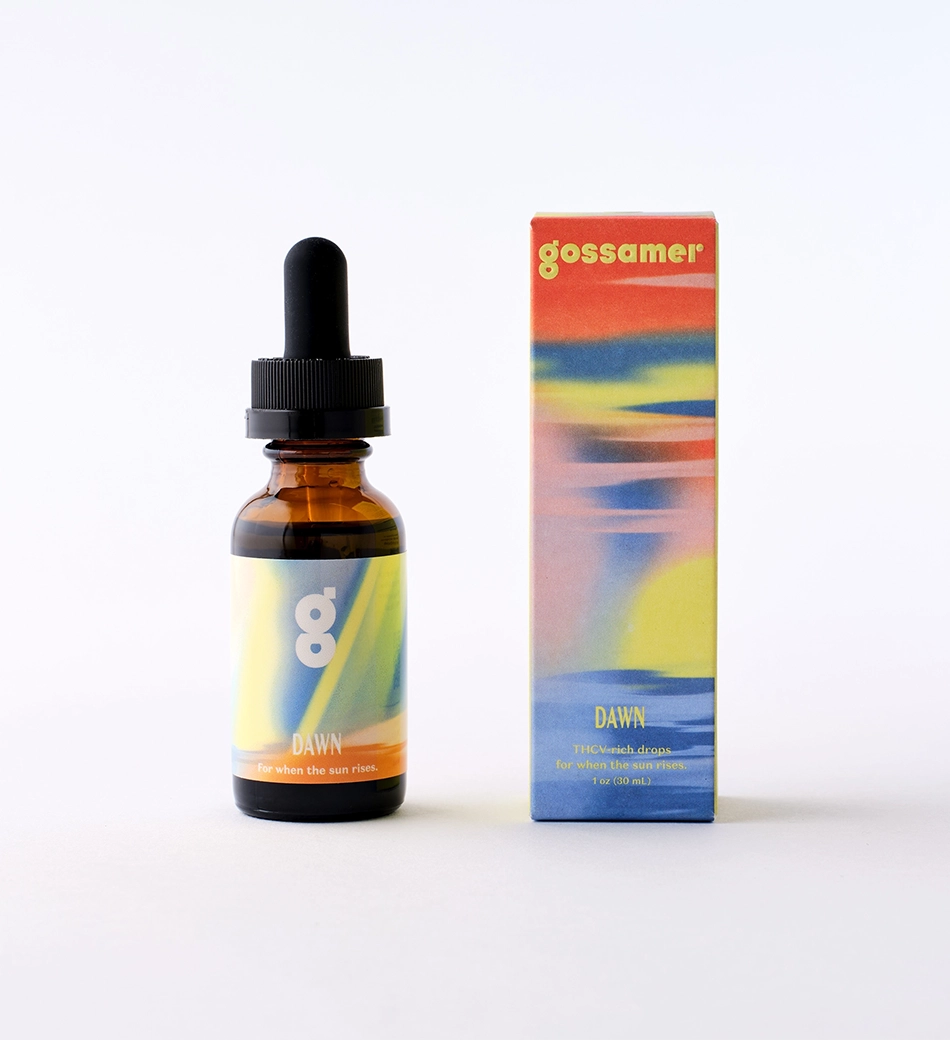
GossamerDawn - 2.5mg THC and 3mg THCVRegular price $70.00Regular price Sale price $70.00Unit price per -
Vendor:
Yew YewZoom Zoom Watermelon Refill Bags - 10mg THC and CBGRegular price $40.00Regular price Sale price $40.00Unit price per